Career change resume: how to make your experience transferable
A practical guide to rewriting your resume when changing roles or industries, with transferable skills, concrete examples, and a clear direction.

Changing careers does not mean starting from zero. It means explaining which parts of your previous experience still create value in the new role.
The problem is that many career-change resumes are still written for the old job. They list responsibilities, tools, and results that made sense in the previous context, but they do not help the reader understand why the profile can work now.
Core idea
A career change resume should not erase your past. It should translate it into the language of the target role.
Start with a direction, not your full history
The first mistake is opening your old resume and trying to polish it. If you are changing roles or industries, first define the destination: customer success, project coordination, HR, marketing, data analysis, administration, operations.
Without a direction, every experience can look potentially useful and the resume becomes unfocused. With a direction, you can choose what to keep, what to move up, and what to cut.
Excelsior OWL’s guide to career change resumes makes this point clearly: a career change resume needs a clear narrative and should highlight transferable skills and relevant experience.

Find the transferable skills that actually matter
Not every skill transfers in the same way. Some words are weak when they stand alone: communication, leadership, problem solving, organization. They become stronger only when tied to context and results.
The Ohio State Career Guide suggests looking across work, projects, volunteering, leadership, activities, and education to identify skills that can apply to future opportunities. The point is not to say “I communicate well.” It is to show who you communicated with, toward what goal, and with what responsibility.
Did you manage clients, users, suppliers, or stakeholders?
Did you coordinate tasks, deadlines, schedules, priorities, or projects?
Did you use data, reports, digital tools, or repeatable processes?
Did you train people, write procedures, or improve a workflow?
Did you solve problems under pressure or in complex situations?
These questions help you extract evidence, not labels.
Rewrite experience for the new role
A career change resume should not lie. It should change perspective.
Before
Managed store operations, assisted customers, restocked products, and supported sales.
After, for an operations role
Coordinated daily store priorities, managing stock availability, product checks, and team alignment during peak traffic and weekly sales targets.
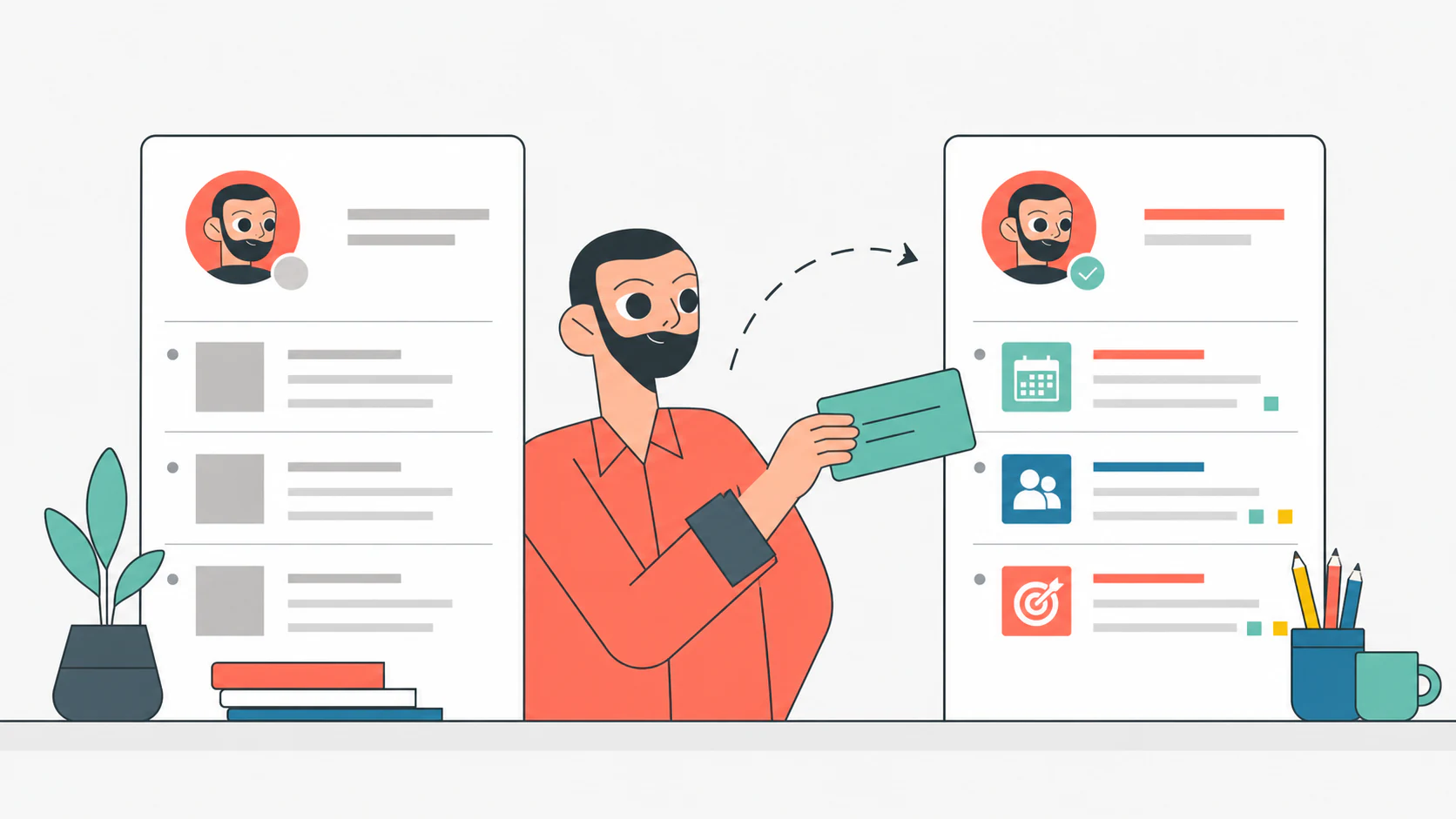
The second version does not invent a new job. It highlights the parts that speak to the target role: priorities, inventory, coordination, and goals.
Use a short, explicit summary
For a career change, the opening summary can help. It should not be a long motivational statement. It should explain the bridge between your previous experience and target role in a few lines.
Example:
Professional with experience in retail operations and customer management, now targeting customer success roles. I bring skills in needs analysis, operational coordination, prioritization, and customer communication in high-pressure environments.
This works because it does not hide the starting point. It connects it to the direction.
Move up what reduces doubt
When someone reads a career change resume, they have an implicit question: “Why would this person work here?”.
Answer that as early as possible. You can use:
- a targeted summary;
- a selective skills section;
- relevant projects;
- recent courses or certifications;
- experience bullets rewritten around the target role.
If you completed a course, built a portfolio, created a project, or volunteered in a way that connects to the new field, do not bury it at the bottom.
Cut details that only belong to the old industry
Your resume does not need to tell your whole past. It needs to make the useful part of your past readable for the future role.
Avoid spending too much space on:
- tools that are too specific to the old industry and do not transfer;
- internal processes the reader will not understand;
- achievements that are strong but irrelevant to the new role;
- repetitive duties that do not prove transferable skills.
This does not reduce your experience. It uses the space better.
Connect the resume and cover letter
The resume should show evidence. The cover letter can explain the transition.
If the career change is significant, do not overload the resume summary with everything. Use the cover letter to make the move explicit, and use the resume to prove you are not starting from zero. The CVpop guide on the first sentence of your cover letter can help you avoid generic openings.
If you are adapting your wording to the job description, also read the guide on ATS resume keywords: in a career change, keywords only help when they describe real skills.
Final checklist
Before sending the resume, check these points.
Is the target role clear in the first few lines?
Are old experiences rewritten for the new context?
Is every transferable skill supported by an example?
Did you remove details only meaningful in the old industry?
Does the cover letter explain the transition without repeating the whole resume?
FAQ
Should I use a functional resume?
It can help in some cases, but it is not mandatory. A combination format often works well: targeted summary and relevant skills at the top, followed by chronological experience rewritten around the target role.
Should I hide my old industry?
No. Hiding it creates confusion. It is better to show it and translate the experience into skills useful in the new context.
What if I have no direct experience in the new role?
Use indirect proof: projects, training, volunteering, tools, portfolio work, outcomes, and transferable responsibilities. If you are almost starting from zero, the guide on writing a resume with no work experience may also help.
A career change becomes credible when the resume does not ask the recruiter to make the connection alone. Your job is to build that bridge: clear wording, real evidence, and an order of information designed for the role you want.
Want to turn these tips into a ready resume?
Use CVpop to build, review, and tailor your resume with guided sections.
Create your resume