Employment gap on your resume: how to explain it clearly
A practical guide to handling a career break on your resume: when to mention it, where to place it, and how to write it without sounding defensive.

An employment gap does not automatically weaken your resume. It becomes a problem when it leaves an open question and the recruiter has to guess the answer.
If the break is short, clean date formatting may be enough. If it is long or recent, a brief explanation can make the resume easier to read without turning it into a personal defense.
Core idea
Treat a resume gap as context: short, factual, and connected to your readiness for the role.
First: is it really a gap?
Not every period without a job needs to be explained. Some intervals are normal: a contract ended, a move, a few months of job search, a training period, or time between two roles.
The question is whether the reader will notice it.

As a practical rule:
- if the gap is only a few weeks, you usually do not need to mention it;
- if it is a few months, consistent month/year or year/year dates may be enough;
- if it is six months or more, especially if recent, a short explanation can reduce doubt;
- if it involved education, caregiving, freelance work, volunteering, or projects, you can turn it into a concise entry.
The Oregon State University Career Development Center recommends handling job gaps clearly and preparing a consistent explanation for both the resume and the interview.
Where should you explain it: resume, cover letter, or interview?
You do not need to explain everything on the resume. You need to choose the right place.
Use the resume when the gap is obvious and could look unexplained. In that case, one line in the timeline or a short entry is enough.
Use the cover letter when the gap is part of a larger transition: returning to work, changing industries, studying, relocating, caregiving, or restarting after a personal period.
Use the interview for detail. A resume is not the place for long, emotional, or private explanations.
If you want to open the cover letter with context instead of a generic sentence, use the CVpop guide on the first sentence of a cover letter.
The best formula: reason, period, readiness
A good explanation does not need to prove that the gap was ideal. It needs to reassure the reader on three points:
- what happened, briefly;
- when it happened;
- why you are now ready and relevant for the role.
Example:
Career break for family care, with active job search resumed in May 2026. During this period, I kept my digital skills current and am now targeting administrative roles focused on organization, documentation, and operational support.
This works because it is not dramatic, it does not share unnecessary private details, and it brings the focus back to the role.
VA Careers gives similar guidance: explain the reason simply, then pivot to how the period prepared you for the next step.
Before and after examples
Tone matters. Many candidates write gap explanations that sound like apologies. The resume should stay professional.
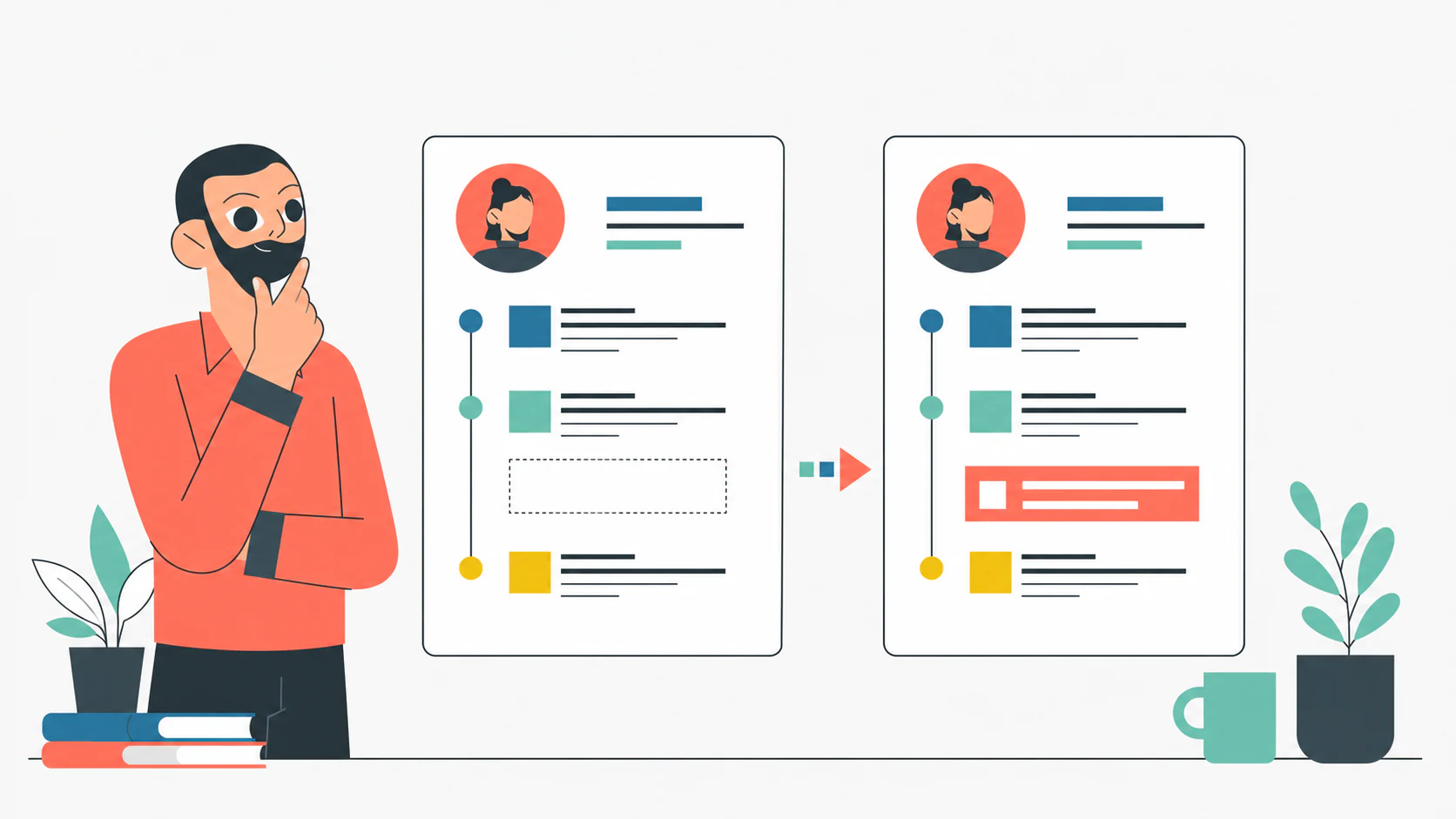
Before
I was unemployed for a long time because I could not find the right opportunity.
After
Period of active job search and professional development, focused on digital tools, targeted applications, and preparation for a return to operational support roles.
Before
I stopped working because of personal problems.
After
Career break for resolved personal reasons; now available for a stable return to roles aligned with administrative experience and document management.
Before
I was not working because I had to take care of my family.
After
Career break for family care, including daily organization and priority management responsibilities. Available to return full time from June 2026.
If you did something during the gap, make it concrete
A gap does not become useful because you call it “personal growth.” It becomes useful when you can connect it to real activities, responsibilities, or skills.
You can mention:
- relevant courses or certifications;
- volunteering;
- freelance or consulting work, even if occasional;
- personal projects you can show;
- caregiving or family management responsibilities, if presented with restraint;
- updates in tools, processes, languages, or software;
- portfolio work or practice projects related to the target role.
The MySECO / Military OneSource guide on employment gaps suggests highlighting relevant activities such as volunteering, education, certifications, and skill development when they support the career goal.
Did you complete training that matters for the role?
Did you produce something you can show?
Did you manage real organizational responsibilities?
Did you update tools, languages, or digital skills?
Did you do freelance work, even inconsistently?
Do not fill the gap with empty phrases
Avoid phrases like:
- “period of personal growth” with no example;
- “looking for new challenges”;
- “time to reflect on my future”;
- “employment inactivity”;
- long explanations about health, family, or private issues.
If you cannot or do not want to share the reason, keep it general:
Career break for personal reasons, now concluded. Available to return to customer care and client management roles.
A restrained sentence is better than a defensive paragraph.
Be careful with dates
Many candidates try to hide a gap by changing date formats only in one part of the resume. That usually makes the timeline look manipulated.
Choose one format and keep it consistent:
- month/year if your experience is recent and sequence matters;
- year/year if you have a longer career and monthly detail adds little value;
- exact dates only when required or normal for the country or sector.
If you also need to align the resume with a job posting, read the CVpop guide on ATS resume keywords: a well-explained gap will not fix a resume that is not targeted.
How to place it in the resume structure
You have three usable formats.
Timeline entry
Useful when the gap is long and recent.
Career break for family care
2024 - 2025
Managed family organization responsibilities; updated Office and digital administration skills; planned return to work in 2026.
One line in the resume summary
Useful when you want to answer the question early.
After a career break for training and professional refocus, I am seeking a junior administrative role where I can apply organization, documentation, and internal client support skills.
No resume entry, cover letter only
Useful when the gap is less visible or the explanation is sensitive. In that case, the resume stays focused on evidence, while the cover letter gives context.
Mistakes to avoid
Do not invent jobs to cover a blank period.
Do not include private details that are not needed.
Do not sound guilty or apologetic.
Do not add irrelevant courses just to fill space.
Do not let the gap become the most visible information on the page.
If your overall experience is limited, the guide on a resume with no work experience can also help: the logic is similar, because the goal is to turn non-linear activity into readable proof.
FAQ
Should I always explain an employment gap on my resume?
No. If it is short, old, or not very visible, you may not need to mention it. Explain it when the gap is long or recent enough to create a reasonable question.
Do I need to give the exact reason?
Only if it is useful and not too personal. Broad phrases such as “personal reasons,” “family care,” “training,” or “returning after a career break” can be enough.
Is it better to hide months?
It depends on the profile. Using years only can be normal for longer careers, but it must be consistent across the whole resume. Do not switch formats only to hide one period.
Should I mention health?
You can, but you do not have to share details. In many cases, it is enough to say the break has concluded and you are available to return.
An employment gap should not become the center of the application. It should be a clear, proportionate line that closes the question. Then the resume should return to the main point: what you can do, for which role, with what evidence.
Want to turn these tips into a ready resume?
Use CVpop to build, review, and tailor your resume with guided sections.
Create your resume