Europass CV: when to use it and when to choose another format
A practical guide to deciding whether a Europass CV is the right format for your application, or whether a more targeted resume will work better.

The Europass CV is not the best choice for every application, and it is not a format you should always avoid. It is a standard, recognizable tool that can be useful in many European contexts. But it is not always the strongest way to present your profile.
The right question is not “Should I use Europass or not?”. The better question is: “For this application, does Europass help the reader understand my profile faster, or does it make the resume longer and less targeted?”.
Practical rule
If the application requires Europass, use it. If it does not, choose the format that makes your role, relevant experience, and evidence easiest to read.
What the Europass CV actually is
The Europass CV is one of the best-known CV formats in Europe. The official platform lets you create a profile with your education, work experience, skills, and achievements, then generate different CVs by selecting what to include.
Europass is useful because it gives you a recognizable structure. It is designed for work, education, training, and volunteering applications, especially where European mobility matters. You can create, save, and share CVs in multiple languages and connect them to European services such as EURES.
The weakness appears when you use it without editing. If you include everything, the CV can become long, uniform, and less focused on the role.

When Europass is a good choice
Europass is a good choice in three situations.
The employer, institution, university, or program explicitly asks for it.
You are applying in a European context where the Europass structure is familiar.
You need to present education, languages, mobility, certifications, or international experience in a standard way.
In these cases, you do not need to be creative with the format. You need to be precise, clear, and selective inside that format.
If your job search is connected to Europe, Europass also explains how to send your Europass CV to EURES, where it can be viewed by EURES advisers and employers. That is a coherent use of the tool: European profile, European mobility, European format.
When another format may work better
For many private-sector applications, especially competitive roles, a shorter and more targeted resume may work better.
Not because Europass is wrong. Because a one- or two-page resume built around the role can surface what matters faster:
- a clear professional title or direction;
- the most relevant experience near the top;
- readable responsibilities and outcomes;
- skills connected to the job description;
- fewer sections that do not help this application.
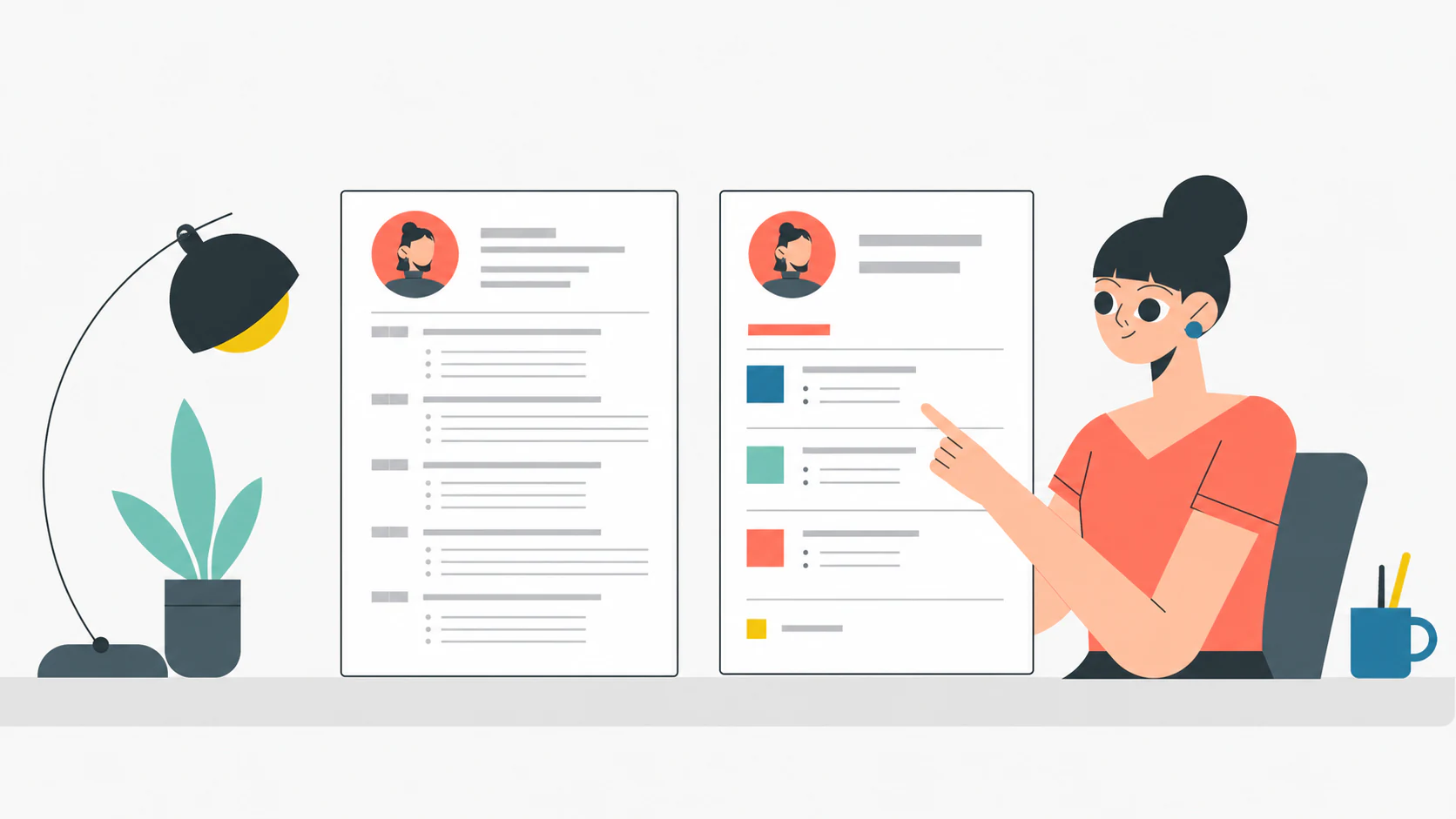
Do not confuse format with content
The format can help, but it cannot save a generic resume. A well-written Europass CV can work better than a modern-looking template with weak content. A visual resume can also fail if it does not explain what you actually did.
Quality still comes down to these questions:
Are the most relevant experiences easy to find?
Is the opening profile tailored to this application?
Are skills supported by real examples?
Does the resume remove details that do not matter for this role?
Can the reader understand your relevance in under one minute?
If the answer is no, changing templates is not enough.
How to make Europass stronger
If you need to use Europass, treat it as a tailored CV, not as a full archive.
Mistake
Including every experience, course, and skill because the Europass profile lets you store them.
Better
Create a specific version for the application, including only the information that helps evaluate you for that role.
The Europass guidance itself recommends highlighting skills and experiences that match the job and updating the “About Me” section for the application. That is the step many candidates skip.
Checklist for choosing the format
Before sending, check this.
Is Europass explicitly required?
Is the application connected to European institutions, education, or mobility?
Does the Europass CV stay readable and no longer than necessary?
Would a shorter format make your experience clearer?
Have you tailored content, keywords, and section order to the job description?
If you are adapting your wording to a job posting, read the CVpop guide on ATS resume keywords. If you are early in your career, the guide on writing a resume with no work experience can help you decide what to include.
FAQ
Is the Europass CV mandatory?
Only when the employer, program, institution, or application process asks for it. If it is not required, you can choose another format as long as it is clear, readable, and relevant.
Is Europass good for applying abroad?
It can be useful, especially in European, education, mobility, and institutional contexts. For private companies, always check whether the format helps or slows down the reader.
Can I keep both a Europass CV and a regular resume?
Yes. That is often the most practical choice: keep a Europass version for contexts that require it and a more targeted version for applications where you want more control over structure and priority.
The right format is the one that reduces the reader’s work. Use Europass when it makes your profile easier to understand. Choose a more targeted resume when Europass adds length without adding evidence.
Want to turn these tips into a ready resume?
Use CVpop to build, review, and tailor your resume with guided sections.
Create your resume